Where is the mind located?
Yet the idea that animals are psychological creatures like humans is still met with resistance. The issue here is that you can only directly observe your own psychological processes. And only the conscious ones at that. Though scientists get ever better at using scanners to measure brain activity, it is impossible to directly record all psychological processes. At the most you can make general statements about activity in certain brain areas that usually seem to be connected with certain mental activities. Researcher John Lorber has reported on people suffering from hydrocephalus who hardly had a neocortex at all but functioned normally.
Descartes and consciousness in animals
The relationship between the brain and the mind is apparently not a one-to-one relationship. And even if it were, we still could not perform any physical measurements on the mind at the present state of the art, because a thought as such is not the same as a series of nerve impulses. As a matter of fact, this view has already been formulated in the 17th century by the French philosopher René Descartes. For that exact reason he did not believe in the existence of a consciousness in animals. Animals to him were impressive robots without any real thoughts or feelings. In this way Descartes became in fact the modern father of the issue of consciousness in animals.
By now three hundred years are over, but according to many the controversy still has not been solved satisfactorily. Even in 1997 psychologist Bermond said that probably only a few species can be expected to possess consciousness. According to him, those are humans, apes and possibly dolphins and cetaceans. These animals, like humans, possess a pronounced neocortex. In humans this neocortex seems to be closely related to conscious experiences. When something is wrong with this brain structure, a part of human consciousness (usually) fails.
Deriving consciousness from behavior
If one focuses only on the brain of a certain animal species and uses the human brain as a standard, one reaches such conclusions. Those conclusions are most likely unfounded. Instead of using specific human brain structures as a standard, it is better to assume the fact that the brains of humans and animals are generally much alike and therefore it is to be expected that there are many similarities in perception. The most important criterion here is not brain structure, but behavior.
If certain behavior leads to the suspicion that there is a form of perception, the lack of a specific structure in the animal brain is no conclusive evidence to the contrary. If this were the case, we wouldn't know what to do with exceptions like the hydrocephalus patients John Lorber documented. We shouldn't therefore focus too much on similarities in brain structure, but should concentrate much more on similarities in behavior. Doing this, we see that certainly birds and mammals are complex psychological creatures in which we can expect complex forms of consciousness.
Our domesticated prey
Animal psychology in the form of research into psychological processes and consciousness in animals is very important. First of all because of the interesting information this produces. Mapping out animal psychology is the counterpart of mapping out their biology. Only then the picture we have of animal life will be complete and only then we can correctly define our own position within the animal kingdom.
But aside from the scientific interest there is an ethical side to modern research into animal psychology. The more we learn about animals as psychological beings, the greater our responsibility towards them becomes. Imagine that research shows that a certain food has a flavor that some animals don't like at all, it would be unethical to feed it to them again and again. This example is rather trivial.
Speciesism and discrimination
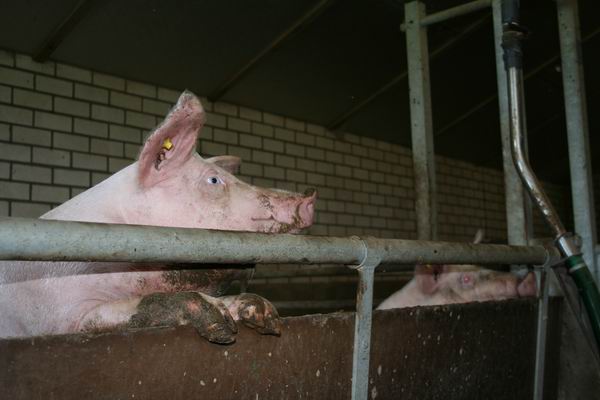
From time immemorial homo sapiens has used animals as he saw fit. And this concerns only partially primitive creatures such as worms or oysters. Usually it concerns, now and in the past, more complex mammals, such as pigs, that humans keep as a kind of domesticated prey.
The average 'civilized' person, however, does not come into contact with the practice of cattle breeding. This is something almost exclusively farmers, truck drivers and personnel of slaughterhouses deal with. Only when things go terribly wrong, such as in the case of mad-cow disease or the destructive swine fever, do we realize where our pork chops and steaks actually come from.
Luckily people are still shocked when they see that pigs and piglets are destroyed 'preventively', yet we are used to applying double standards. Australian philosopher Peter Singer speaks of speciesism in this context, discriminating other species just because they are not human.
On the road to knowledge of well-being
Speciesism is in part the consequence of a lack of understanding that pigs, cows, sheep, goats and so on are sensitive and sometimes even quite intelligent animals. The general public is still hardly aware of the available knowledge. The story that animals killed for human consumption at least have had a good life is in most cases untrue.
Even in a free-range situation an animal is stuck with far too many animals of the same species and because of this they cannot function normally. This is true, for example, for pigs, who need a varied environment to satisfy their need to explore, but just as much for chickens, who pick each other's feathers or boxed calves who literally can't move.
The contradiction of well-being research
In a way it is unheard of that so-called psychological research into the well-being of livestock is being done, when one realizes that the results of this research are hardly incorporated in agricultural policy. On the one hand such research recognizes that animals are psychological beings and as such should be respected, on the other hand this is being done within the framework of 'speciesism' that is only directed at the use of animals as economic objects.
If we are optimistically inclined, we may expect that, as has been predicted in the TV show 'Star Trek', humans in the future will lead a vegetarian lifestyle. Dolphins need fish, but humans can thrive on a vegetarian diet.
This article was published in the Dutch magazine Psychologie, July/August 1997 pp 22-24.
See also: Consciousness in animals; Bob Bermond doubts that animals can suffer and feel pain; Nice doggie! Affection in the Animal Kingdom. |