Habitats must be connected
Animals and plants in the wild need enough habitat to be able to survive. If a nature area is too small, it can be made viable by connecting it to another area through a "green corridor": a wildlife bridge, a nature-friendly riverbank or a strip of woodland. Together the areas give a species a real chance. Such a landscape is also more attractive for walking and cycling.
In 1990 the Dutch government started the National Ecological Network (in Dutch: Ecologische Hoofdstructuur, EHS): a network of existing nature, new nature to be created and farmland where farmers make agreements to spare nature. In 2013 the EHS was renamed Nature Network Netherlands (Natuurnetwerk Nederland, NNN). Since then the provinces have been responsible for it. Around 2000 the government tried to concentrate intensive livestock farming in areas far away from nature. This was called reconstruction.
Waterways play an important role: the large rivers, but also the small ditches along the fields. Because of global warming, habitats are shifting. That makes it even more important that plants and animals can move along, otherwise they will die out.
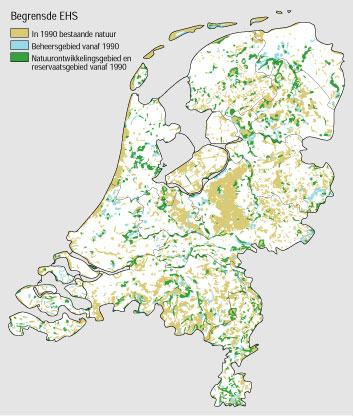 This map by the Dutch National Institute for Public Health and the Environment (RIVM) shows how the network was planned around 2000: what was already nature and what still had to be "made". In provinces such as Groningen and Limburg nature was still very fragmented. Local authorities and farmers did not exactly cooperate. Land zoned for industry earns more money. This map by the Dutch National Institute for Public Health and the Environment (RIVM) shows how the network was planned around 2000: what was already nature and what still had to be "made". In provinces such as Groningen and Limburg nature was still very fragmented. Local authorities and farmers did not exactly cooperate. Land zoned for industry earns more money.
The Nature Network in figures
- The Nature Network Netherlands is eventually to cover about 750,000 hectares.
- The national government and the provinces agreed to create 80,000 hectares of new nature by the end of 2027. By early 2025 just over 53,000 hectares had been completed. In 2024, 2,537 hectares were added. At this pace the new nature will not be finished until around 2036.
- The 162 Natura 2000 sites in the Netherlands are protected under European law. They cover about 9 percent of the land area and almost all lie within the Nature Network.
- In 2022, 26 percent of the land and inland waters was protected nature. The target of the European Union and the United Nations is 30 percent by 2030.
- In 2024 only 31 percent of the nitrogen-sensitive nature in Natura 2000 sites received no more nitrogen than it can tolerate. By law this must be 40 percent in 2025, 50 percent in 2030 and 74 percent in 2035.
- Between 2005 and 2024 nitrogen deposition on Natura 2000 sites fell by about 29 percent. Deposition from industry and traffic fell by 37 percent, from agriculture by only 15 percent.
Nature targets
In 1992 the Netherlands signed the United Nations Convention on Biological Diversity. In 2010 the countries agreed that by 2020, 17 percent of the land should be protected nature. In 2022 this became 30 percent by 2030, on land as well as at sea. The European Union has the same target.
The fact that an area has been designated as nature does not mean it will actually become nature or that this will happen soon. A lot can still get in the way. Economic pressure keeps nibbling away at the plans and thus at the space for nature.
The Dutch nature conservation organisations Natuurmonumenten and Staatsbosbeheer have been calling for faster land purchases for years. Because land prices keep rising, buying sooner saves a lot of money, at least if the government wants to keep its promises. Buying land is the most effective way to protect nature.
There is also valuable nature outside the Nature Network. An example is the habitat of badgers and European hamsters in the south of the Netherlands. Because the number of hectares is limited, valuable areas are left out. As early as 2000, Frans Vera, then a policy officer at the Dutch Ministry of Agriculture, said in NRC Handelsblad: "If we believe that nature is as important as agriculture, the reallocation will be at the expense of agriculture".
Farmers can also contribute. Since 2016 they have been paid through agricultural collectives for nature management on their land, for example when they mow later so that meadow birds can raise their young.
Pollution does not respect boundaries
It is important to keep pollution out of the Nature Network. If food in nature becomes scarce or biodiversity declines because of pollution, animals have to look for food outside it. Then they are more likely to become road casualties or to cause damage.
Factors that disturb nature are light, noise, fragmentation, mechanical and visual disturbance, changes in species, vibration, waterlogging, drought and, above all, eutrophication and acidification. These last two largely come from livestock farming: ammonia from manure is deposited on nature as nitrogen. Groundwater suffers as well. In the sandy regions, shallow groundwater in many places contains more nitrate than the European standard allows. Too much nitrate in drinking water is harmful to babies.
Sources (in Dutch): Environmental Data Compendium (CLO), Realisatie Natuurnetwerk (April 2026) and Aandeel beschermde natuurgebieden (2023); RIVM, Dalende trend stikstofdepositie op Natura 2000-gebieden (2026); Natura 2000-gebieden; Natuurnetwerk Nederland. Updated October 2026.
See also: Can the honeybee survive in nature?. |
