The law should also protect the interests of animals
The law for humans is based on the defense of interests. In the case of animals, this has also been regulated in the Netherlands, in the Health and Welfare Law for Animals (replaced in 2013 by the Animals Act), the Experiments on Animals Act and the Flora and Fauna Law (replaced in 2017 by the Nature Conservation Act, which has been part of the Environment and Planning Act since 2024). Animals, however, cannot stand up for their own interests and it is very difficult for humans to express those interests for them.
For humans, the priorities are mainly freedom and money. In the case of animals, money never enters the question, nor does freedom, strangely enough. At least that is how it seems when we see how rarely humans stand up for the freedom of animals. Humans do speak out where visible animal suffering is evident, but that is not enough to be able to speak of fair treatment.
The five freedoms and natural behaviour
Five fundamental freedoms have been formulated for farm animals. They cover most animal needs, including the freedom to behave naturally. But that last freedom is usually ignored by producers and consumers.
The needs of housing, food and drink and prevention of diseases in animals are generally well catered for by humans. When this is not the case, others rightfully become indignant and animal protection authorities will take action where necessary. But the freedom of animals to live in conditions where they can behave naturally often falls short of the mark, even though it is included in their rights (the five freedoms).
Why people do not see this
Perhaps people have a blind spot for this. We know that, in order to maintain our freedom, we often need to make choices. Also, some fundamental needs, such as hunger and thirst, have such a high priority that others fade in significance by comparison. Such matters are, however, normally well regulated: even on a global level, a surplus of food is more of a problem than a shortage. Obesity and food waste are the result.
It is in the interests of both humans and animals that they have sufficient food, safety, rest and relaxation. In adulthood, humans desire a family life, but the majority of production animals do not get that far: as soon as they are fully grown or milked out, they are slaughtered. They have reached their (final) goal. Killing animals is not pleasant, but is logical in an economic production system geared to meat consumption.
The invisible suffering of production animals
As most animals die so young and protection of production animals often stops at the prevention of visible suffering, the majority of humans are unaware of the invisible suffering of animals. It is difficult for humans to imagine that not being able to behave in a natural way can be torture for animals. We humans have, after all, been raised from a young age to live a life in which all naturalness has faded into the background. We can live with this, because we are able to influence it.
By removing production animals and many pets from their natural environment like slaves and keeping them away from it, we have taken this influence away from them. The natural environment is also becoming smaller and smaller. The living space is sometimes so small that animals such as orangutans and polar bears are safer nowadays in zoos than in their natural environment. Many meat-eaters reason the same way: "They have a much better and safer life than in the wild, don't they?"
Freedom as an interest of animals
Along the way, the Earth has become so small that some truth seems to appear in this reversal of cause and effect. But what we are actually doing is turning the world of justice upside down.
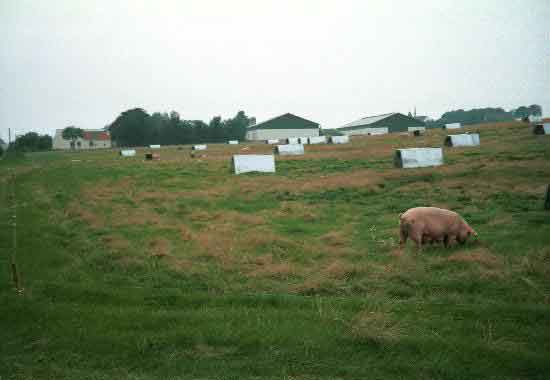
In our efforts to obtain so much freedom for ourselves, we have soiled the quality of the living space of others. When freedom is increased in the correct manner, this increases the freedom of all concerned. To make a firm stand for animal interests, we should strive for the freedom of animals to fulfil their natural needs themselves. |

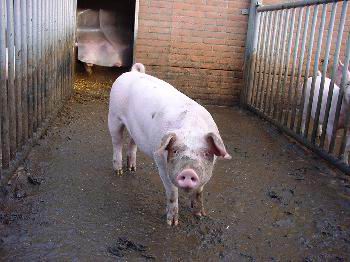 This is the space afforded to an organically raised Dutch pig in order to fulfil his or her natural needs: a run with a concrete floor.