Is it necessary to slaughter an animal without stunning?
Muslims only eat meat from animals that have been slaughtered according to Islamic rules (halal). The throat is cut with a single cut so that the blood can drain away. Jews also have a ritual slaughter. Read more in the animal in Jewish theology.
If an animal is not stunned first, it is fully conscious when its throat is cut. It only loses consciousness when the brain receives too little oxygen. In sheep and goats this usually takes up to about twenty seconds. In cattle it can take more than two minutes. It would therefore save a great deal of suffering if every animal were stunned first, in ritual slaughter too.
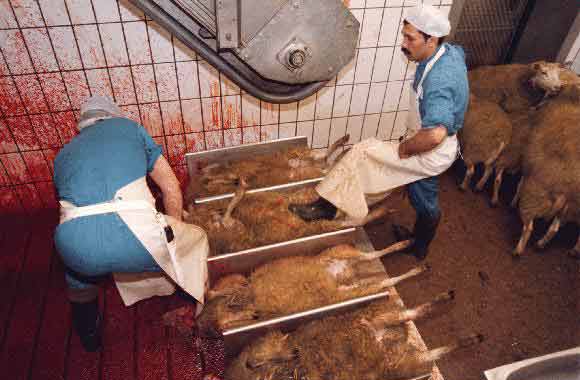 Ritual slaughter of sheep in a slaughterhouse. Photo: Gerard Damoiseaux Ritual slaughter of sheep in a slaughterhouse. Photo: Gerard DamoiseauxStunning and halal go together
In conventional slaughter an animal is stunned first. Cattle are usually shot with a captive bolt gun: a steel bolt damages the cerebrum so that the animal is unconscious at once. Sheep and pigs are often stunned with electricity. The animal is not dead yet. The heart keeps beating, which is intended: this way the animal bleeds out well after the throat is cut.
According to Islamic rules the animal must still be alive at slaughter and be outwardly unharmed. Stunning with an electric shock is reversible: if the throat is not cut afterwards, the animal regains consciousness. Many Islamic scholars therefore consider such stunning permissible. Others object to it. The current must be strong enough though, or the animal is only half stunned.
Practice shows that stunning and halal go together. In England and Wales, 88 percent of all animals slaughtered for halal in 2018 were stunned beforehand. In the Netherlands, 68 percent of the animals slaughtered for Eid al-Adha in 2025 were stunned beforehand. In 2023 this was still 54 percent.
Eid al-Adha, the Feast of Sacrifice
At Eid al-Adha (in Turkish Kurban Bayramı) Muslims commemorate the story of Ibrahim (Abraham), which is also told in the Bible. God tested Ibrahim by asking him to sacrifice his son. In Islamic tradition this is usually Ismail, in the Bible it is Isaac. When Ibrahim was about to obey, God spared the son. A ram was sacrificed in his place. The feast coincides with the hajj, the pilgrimage to Mecca. All Muslims celebrate it, also those who are not on pilgrimage.
Out of gratitude, Muslims who can afford it sacrifice a sheep, a goat or sometimes a cow. The meat is usually divided into three parts: for the family, for relatives and friends and for the poor. In the Netherlands, where Animal Freedom is based, 5 to 6 percent of adults call themselves Muslim. Not all of them have an animal slaughtered.
The rules in the Netherlands
- Slaughter without stunning is only allowed in a slaughterhouse that has permission from the Netherlands Food and Consumer Product Safety Authority (NVWA). Slaughtering an animal at home, in the garden or on a farm is prohibited, also at Eid al-Adha.
- An NVWA veterinarian supervises every ritual slaughter. The slaughterman needs a certificate of competence.
- Since 1 January 2018 the 40-second rule applies: if an animal is still conscious 40 seconds after the cut, it must be stunned after all.
- These rules are laid down in the Animals Act, the Animal Keepers Decree, the European slaughter regulation (1099/2009) and the 2012 covenant on slaughter without stunning, which was supplemented in 2017.
- In 2011 the Dutch House of Representatives passed a bill by the Party for the Animals banning slaughter without stunning. In 2012 the Senate rejected it, citing freedom of religion. The covenant took its place.
- In 2017 more than 65,000 animals were slaughtered for Eid al-Adha. In 2025 this had fallen to just over 24,000.
And in the rest of Europe?
The European slaughter regulation requires stunning, but countries may make an exception for religious slaughter. More and more countries do not.
- Ban on slaughter without stunning: Sweden, Denmark, Slovenia, Flanders and Wallonia (since 2019). Outside the EU: Norway, Switzerland and Iceland.
- Stunning immediately after the cut required: Austria, Estonia, Latvia and Greece. In Finland the cut and stunning must happen at the same time.
- In the Brussels Region, parliament voted against a ban in 2022.
The Court of Justice of the European Union (2020) and the European Court of Human Rights (2024) ruled that such a ban is permitted: animal welfare may limit freedom of religion.
There is an alternative
More and more Muslims in the Netherlands no longer have an animal slaughtered for Eid al-Adha. Many give the money to an aid organisation, which has an animal slaughtered on their behalf in a poor country and hands out the meat to people who cannot buy meat themselves. The Dutch Contact Body for Muslims and Government saw the number of donations grow every year. Some Muslims choose a festive meal without meat. The number of animals slaughtered in the Netherlands for Eid al-Adha fell by almost two thirds between 2017 and 2025.
Islamic scholars differ on whether the sacrifice is compulsory. The Hanafi school, followed by most Turkish Muslims, sees it as a duty (wajib) for those who can afford it. The Maliki school, followed by most Moroccan Muslims, sees it as a strongly recommended practice (sunnah). In all cases it is about gratitude and sharing with those who have less.
A donation spares an animal in the Netherlands a frightening death, but elsewhere an animal is usually still slaughtered. The truly animal-friendly alternative is to give money or food without an animal dying for it. Those who still want a ritual slaughter should preferably choose an animal that has been stunned beforehand. It would be wonderful if Muslims gave up sacrificing animals altogether. That saves animal suffering and earns a lot of goodwill. It would also be a good thing if governments further reduced animal suffering at slaughter. Belgium and Denmark show that compulsory stunning is possible.
True gratitude does not require animal suffering.
Sources: NVWA, Requirements for slaughterhouses for ritual slaughter without stunning and Eid al-Adha (in Dutch); NVWA figures in the Reformatorisch Dagblad (27 May 2026); EFSA, Welfare of cattle at slaughter (2020); Temple Grandin; Food Standards Agency, Slaughter method survey 2018; Library of Congress, Legal Restrictions on Religious Slaughter in Europe (2018); VRT (13 February 2024); NOS (9 July 2022); CBS Statistics Netherlands. Updated October 2026.
See also: Unnecessarily slaughtering according to Islamic law?. |