What to consider before you get a pet
A pet such as a dog does not only have sunny sides. There are a number of things people should think about carefully before taking an animal into their home. A few examples:
- Responsibility
- Time
- Holidays
- Training
- Social limitations
- Microchipping
- Costs
- Land and environment
- Grief
- Old age
Responsibility
Owning a dog is a big responsibility. In everything you do, every day, you have to take the animal into account.
Time
A dog can live for ten to fifteen years. It largely determines how you organise your day. You need to be home every few hours to walk and feed it. Walking, training, playing, brushing and cuddling take up a lot of time every day.
Almost all dogs shed hair, long-haired and short-haired alike. It spreads all over the house and cleaning takes a lot of time. When the dog is moulting you have to clean and brush at least once a day to keep things tidy.
Holidays
When you go on holiday, your pet has to stay somewhere and someone has to look after it.
Training
A dog can have or develop behavioural problems. Good training is very important and not everyone is able to train an animal well. The dog may then destroy furniture. Or it may be aggressive towards people. Some dogs listen to nothing and nobody.
Social limitations
Dogs are not welcome everywhere, for example in shops, restaurants and on public transport. Visiting friends with a dog can also be a problem. Many people, your neighbours for instance, find barking annoying.
Microchipping
More and more countries require dogs (and sometimes cats) to be microchipped and registered in a database. In England every dog must have a microchip since 2016. Since 10 June 2024 the same applies to cats, which must be chipped before they are 20 weeks old. Owners who fail to do so can be fined up to £500. In 2026 the European Union adopted Regulation 2026/1818, which will make microchipping and registration compulsory for all dogs and cats in the EU: for breeders and sellers from 2030, for all dog owners by 2036 and for all cat owners by 2041. Keep your contact details up to date, otherwise the chip is of little use.
Costs
A pet costs a lot of money. On top of the purchase price there are a basket, a lead, food and of course veterinary bills. In many places you also need a licence or have to pay a dog tax. Not every dog stays healthy all its life. With a bit of bad luck the vet bills rise sharply. The extra care also takes a lot of your time.
Land and environment
Pet food requires a lot of land. According to a study by the University of Edinburgh (2020), dry pet food worldwide causes 56 to 151 million tonnes of CO2 equivalent a year. That is 1.1 to 2.9 percent of all agricultural emissions, roughly as much as a country like the Philippines. It uses 41 to 58 million hectares of farmland, about twice the area of the United Kingdom. In the United States alone, dogs and cats account for about a quarter to a third of the environmental impact of animal production, because most of their food comes from animals (Okin, 2017).
Grief
Many pets do not live long compared with humans. When they die, the grief can be very intense.
Old age
As with humans, veterinary medicine can prolong the lives of pets further and further. How far do you go?
Consequences for others
Apart from these drawbacks for yourself, there are also consequences for other animals and for your surroundings:
- Dogs eat meat from factory farms
- Dog mess
Dogs eat meat from factory farms
Dogs are carnivores. The meat in their food almost always comes from animals raised in factory farming. Other food is usually very expensive. Besides, you have many animals killed to feed your own pet.
Dog mess
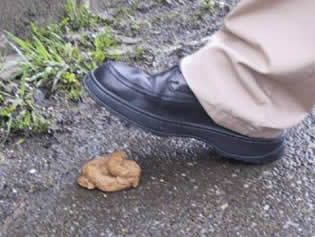 Dog mess causes a lot of nuisance and is one of the things people complain about most. It lies on pavements and playing fields, but also on woodland paths. It smells and sticks to shoes and clothes. Cleaning it up costs local authorities a lot of money. In many places dog owners are required by law to pick it up. Dog mess causes a lot of nuisance and is one of the things people complain about most. It lies on pavements and playing fields, but also on woodland paths. It smells and sticks to shoes and clothes. Cleaning it up costs local authorities a lot of money. In many places dog owners are required by law to pick it up.
Finally
By taking the dog as an example, we have looked at several factors that people do not usually stop to think about. Not all, but most of the arguments also apply to other pets. On the other hand, some factors apply to other pets but not to dogs. Do these human arguments outweigh the interests of the animal?
Let us also take a look at the industry behind keeping pets.
Sources: RSPCA, cat microchipping; Regulation (EU) 2026/1818; Alexander et al., The global environmental paw print of pet food (Global Environmental Change, 2020); Okin, Environmental impacts of food consumption by dogs and cats (PLOS ONE, 2017). Updated October 2026. |
