10 myths about vegans |
List of myths1. "Vegans are the pale anemic bunch"No way Jose! Olympic champion Carl Lewis, gorgeous Alicia Silverstone and hot Joaquin Phoenix are amongst famous vegan hotties. 2. "If you want to know what's in fashion, don't bother asking a vegan"The best fashion accessory for vegans is the one matching their beliefs. The mainstream has now caught on that "Green is the new Black" and compassionate fashion is in vogue. Stella McCartney is one among many designers who refuses to use fur or leather in any of her prêt-à-porter collections. 3. "Vegans are fruit loops"There may be a few fruit loops amongst them but there are some rather brilliant minds too, such as the late Janez Drnovšek, president of Slovenia from 2002 to 2007. Maybe tofu is the next brain food. 4. "Vegans live on rabbit food"Rabbits would be jealous. Think of lentils, chickpeas, beans, tofu, tempeh, nuts, pasta, curries and burgers. Many cuisines, from Indian and Ethiopian to Middle Eastern, have been largely plant-based for centuries. 5. "Vegan = stylish footwear = oxymoron"Not anymore! Happy vegan feet can now step out in style. Vegan shoes are widely available, from specialist vegan labels to mainstream brands. 6. "Vegans love animals more than people"The furry, scaly and warty ones are their passion but high on their priorities too is the welfare of their fellow 2-legged Homo sapiens variety. Wherever possible, vegans look out for fair trade produce; see the Fairtrade Foundation for further information. 7. "Vegans will not rest until they convert the entire world into vegans"They would love everyone to be vegan of course but they do understand that this is the real world. Another way around is to set up a little country of vegans! 8. "Vegans are all humourless, angry extremists"You can speak out for animals and have fun at the same time too. For years, one such "cheeky" way was getting your gear off and running nude through the streets of Pamplona, in protest against the running of the bulls. Intrigued? See the Pamplona protests of PETA (People for the Ethical Treatment of Animals). 9. "Vegans are tree huggers"Indeed they are and they love hugging lots of other things too! Actually, veganism and environmentalism go hand in hand. Did you know that farmed animals (think of the methane that cows burp up) produce roughly as much greenhouse gas as the world's entire transport sector? According to the FAO, livestock accounts for about 12 to 14.5% of global emissions. For transport the IPCC gives about 15%. 10. "Vegans have a chip on their shoulders""Let's say you were stranded on a deserted island and your only food source was a turtle, would you eat it...?" As a counterbalance to these myths, here are 20 health benefits of going vegan according to science. See also: The attitude (eating) behavior model projected behind veganism; Eating meat: the consequences for animals, environment, climate and world food; Suggestions for a Tasty and Healthy Vegetarian Diet. |
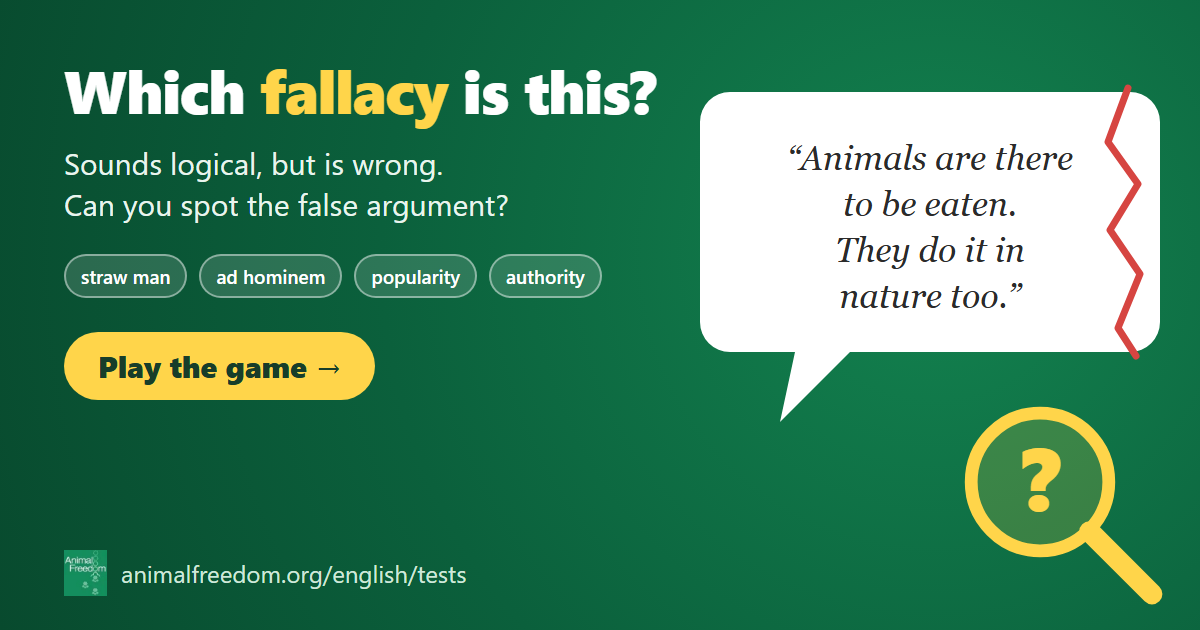
Test yourself: which fallacy is this? Ten statements about animals that you hear all the time. Can you spot the fallacy? After each answer you read why it does not hold. Play the game → |
This article is part of a series on fallacies and demagogy |
Some arguments used in debate on the topics in the title simply are invalid. That goes for pro and contra. We selected a few of the most rigid arguments from different situations and placed an appropriate counterargument. Because a more clear and honest way of reasoning helps improve the circumstances animals live in. Apart from the specific issues there are the types of arguments in general. Fallacies are deliberately or accidentally used in a debate. So be aware of the principles and the integrity of an opponent. How do you respond to fallacies? Six tipsGive the other person the benefit of the doubt. Start by assuming a misunderstanding, not deliberate deception. Even someone who keeps using fallacies may simply be badly informed or emotionally involved.
See also how to respond to animal-unfriendly behaviour of others. |
Non-valid arguments (deceptive arguments) for different groups |
 |
|
|||||