Fallacies surrounding the defence of hunting for pleasure

False arguments for recreational hunting refuted

City dwellers who rarely visit the countryside have no right to interfere with hunting.
The scarce amount of time that city dwellers spend in the countryside does not deny them the right to participate in discussions about the welfare of flora and fauna.
Hunters help control the numbers of animals in the wild and prevent damage caused by wild animals.
The actions of hunters and Authorities towards natural control of wild animal populations are less than adequate when it comes to prevention of unnecessary killing of animals.
Hunting is natural.
Hunting for pleasure rarely happens in nature; animals only hunt for food.
Hunters invest time and money in nature.
The amount of time a hunter spends in nature and the money he invests in his area does not justify killing off wild animals.
The hunt keeps animal populations healthy.
Whereas hunting by natural predators certainly does,this statement would only ring true if hunters pursued their prey with their bare hands. A hunter who shoots for pleasure cannot prove that he only eliminates sick and weak specimens.
Hunters do all in their power to prevent injuring wild animals.
30-60% of migratory geese die with bullets in their bodies. The most effective way of preventing this, is by not shooting at all.
Some biotopes are too small to allow uncontrolled growth of a population of wild animals.
For this reason ecological networks of protected areas have been introduced in many countries, providing a natural connection between biotopes. In such a network, a natural balance can be achieved, making the hunt superfluous. This should also be set as a minimum demand of such a network.
The hunt is acceptable, as along as we eat what we shoot.
Eating a corpse is no justification for killing live animals.
Why should a wildlife manager not enjoy hunting?
Animals are entitled to prevention of unnecessary klilling. Where wildlife is controlled by people who enjoy hunting, sufficient self control and maximalisation of natural alternatives are unlikely.
If the fox is not hunted, meadow birds will be endangered.
Of course, but the fox and all other predators of meadow birds keep each other in balance. If there was no hunt, nature lovers would see more of both species. The hunt makes animals shy.

See also: Hunters for pleasure aren't needed for balance in nature; Is taking away an animal's freedom worse than killing it?; Should wild animals have the same rights as cattle?.

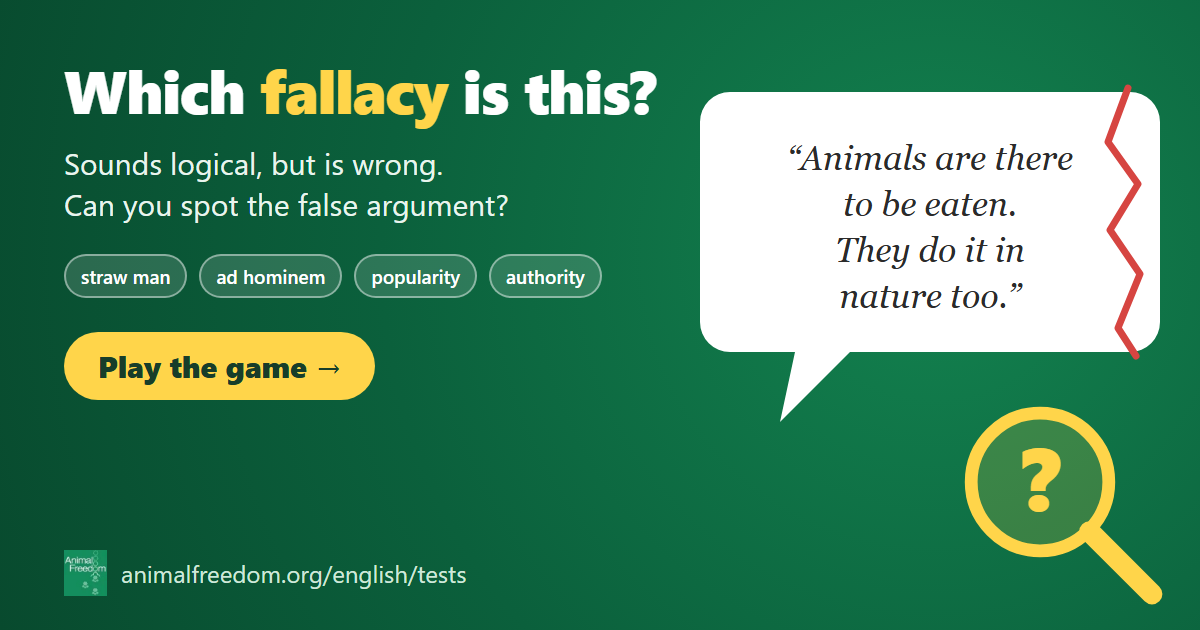
Which fallacy is this? Play the game

Test yourself: which fallacy is this?

Ten statements about animals that you hear all the time. Can you spot the fallacy? After each answer you read why it does not hold.

Play the game →

This article is part of a series on fallacies and demagogy

Some arguments used in debate on the topics in the title simply are invalid. That goes for pro and contra.

We selected a few of the most rigid arguments from different situations and placed an appropriate counterargument.

Because a more clear and honest way of reasoning helps improve the circumstances animals live in. Apart from the specific issues there are the types of arguments in general.

Fallacies are deliberately or accidentally used in a debate.

So be aware of the principles and the integrity of an opponent.

How do you respond to fallacies? Six tips

Give the other person the benefit of the doubt. Start by assuming a misunderstanding, not deliberate deception. Even someone who keeps using fallacies may simply be badly informed or emotionally involved.

  • Mind the context. In a friendly conversation a gentle approach works better than in a formal debate. Adapt to your relationship with the other person and to the aim of the conversation.
  • Stay calm. Fallacies are often meant to stir up emotions. Keep your own emotions in check.
  • Identify the fallacy. Try to understand where the reasoning goes wrong. Do this for yourself, not to catch the other person out.
  • Answer the fallacy. Ask clarifying questions or explain why the argument does not convince you. Avoid technical terms.
  • Stay on topic. Bring the conversation back to what it is about and keep it on a rational level.
  • Be prepared. If you know you will talk to someone who often uses fallacies, gather some facts and arguments beforehand.

See also how to respond to animal-unfriendly behaviour of others.

Non-valid arguments (deceptive arguments) for different groups