Non-valid arguments for abstaining meat

False arguments for not eating meat refuted

Humans are not equipped with the dental and digestive facilities to eat meat.
(Even turned around, this argument is not valid for eating meat) a human can digest meat well when taken in moderation.
People can choose what they want to eat, animals cannot.
That makes us responsible, but it is not an argument against eating meat.
Eating no meat at all is healthier.
That doesn't make eating meat unhealthy.
Killing animals is sad.
That is a personal opinion.
Animals suffer when butchered.
Dying a natural death caused by disease or being taken as prey is at least just as painful.
Humans don't need meat.
Unnecessary food (for example candy) is not always unhealthy or ethically unacceptable.

See also: Is it correct and wise to eat animals?; Eating meat: the consequences for animals, environment, climate and world food.

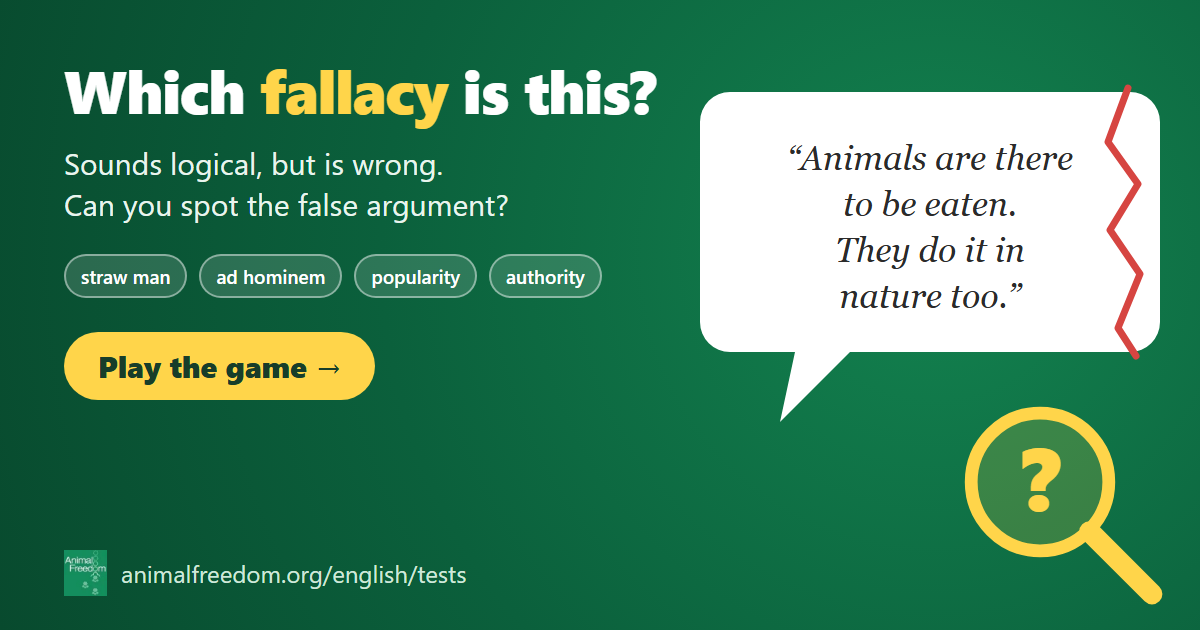
Which fallacy is this? Play the game

Test yourself: which fallacy is this?

Ten statements about animals that you hear all the time. Can you spot the fallacy? After each answer you read why it does not hold.

Play the game →

This article is part of a series on fallacies and demagogy

Some arguments used in debate on the topics in the title simply are invalid. That goes for pro and contra.

We selected a few of the most rigid arguments from different situations and placed an appropriate counterargument.

Because a more clear and honest way of reasoning helps improve the circumstances animals live in. Apart from the specific issues there are the types of arguments in general.

Fallacies are deliberately or accidentally used in a debate.

So be aware of the principles and the integrity of an opponent.

How do you respond to fallacies? Six tips

Give the other person the benefit of the doubt. Start by assuming a misunderstanding, not deliberate deception. Even someone who keeps using fallacies may simply be badly informed or emotionally involved.

  • Mind the context. In a friendly conversation a gentle approach works better than in a formal debate. Adapt to your relationship with the other person and to the aim of the conversation.
  • Stay calm. Fallacies are often meant to stir up emotions. Keep your own emotions in check.
  • Identify the fallacy. Try to understand where the reasoning goes wrong. Do this for yourself, not to catch the other person out.
  • Answer the fallacy. Ask clarifying questions or explain why the argument does not convince you. Avoid technical terms.
  • Stay on topic. Bring the conversation back to what it is about and keep it on a rational level.
  • Be prepared. If you know you will talk to someone who often uses fallacies, gather some facts and arguments beforehand.

See also how to respond to animal-unfriendly behaviour of others.

Non-valid arguments (deceptive arguments) for different groups