Non-valid arguments for taking animal rights too seriously |
|||||||||
See also: Freedom, not similarity, is the basis for animal rights; What if you took your own principles seriously?. |
|||||||||
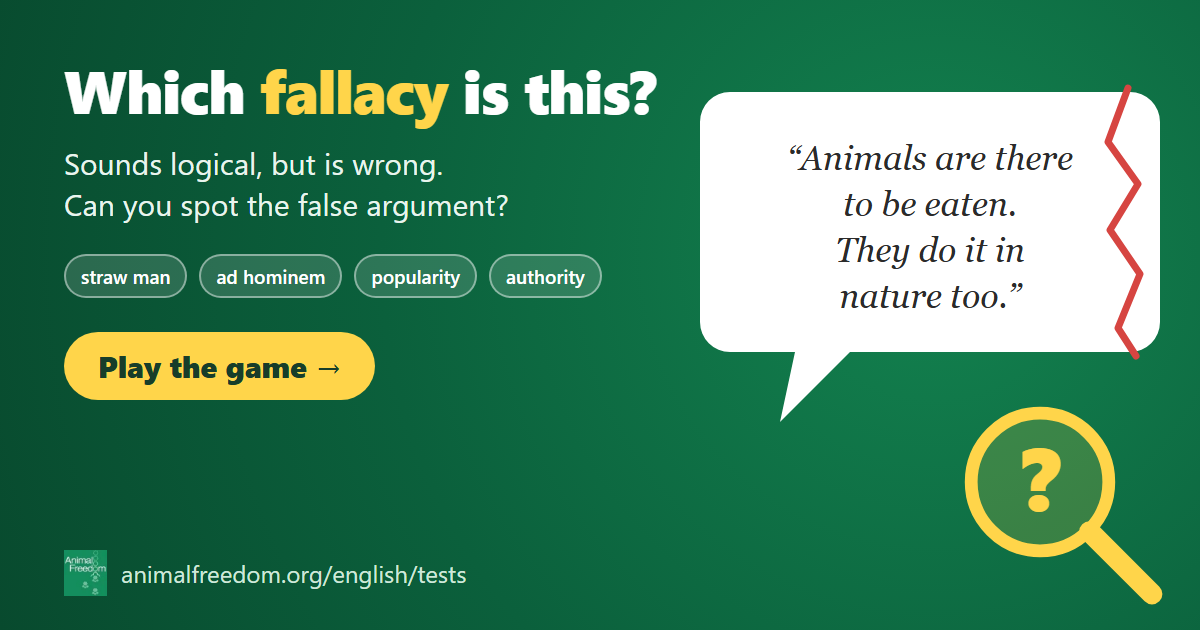
Test yourself: which fallacy is this? Ten statements about animals that you hear all the time. Can you spot the fallacy? After each answer you read why it does not hold. Play the game → |
|||||||||
This article is part of a series on fallacies and demagogy |
|||||||||
Some arguments used in debate on the topics in the title simply are invalid. That goes for pro and contra. We selected a few of the most rigid arguments from different situations and placed an appropriate counterargument. Because a more clear and honest way of reasoning helps improve the circumstances animals live in. Apart from the specific issues there are the types of arguments in general. Fallacies are deliberately or accidentally used in a debate. So be aware of the principles and the integrity of an opponent. How do you respond to fallacies? Six tipsGive the other person the benefit of the doubt. Start by assuming a misunderstanding, not deliberate deception. Even someone who keeps using fallacies may simply be badly informed or emotionally involved.
See also how to respond to animal-unfriendly behaviour of others. |
|||||||||
Non-valid arguments (deceptive arguments) for different groups |
 |
|
|||||