Fallacies that lead to animal suffering

Why it pays to recognise fallacies

Fallacies keep animal suffering going: they make abuse sound like ordinary use. They turn up everywhere: at the dinner table, in advertising, in politics and in the media. Often people use them without even realising it.

You see it most clearly in bullfighting: animal suffering that serves no purpose other than entertainment and that is still defended as culture. You see it least in something most people consider harmless: eating meat. Yet this is by far the largest source of animal suffering. In the Netherlands alone, 518 million chickens were slaughtered in 2025, on average more than 1.4 million a day. Precisely because eating meat is so normal, the fallacies that keep it going hardly stand out.

Anyone who speaks out against it often runs into a wall. Arguments are brushed aside, ridiculed or turned around. The conversation ends in a power struggle. That frustration is understandable. But fallacies are often designed to stir up emotions. Whoever gets carried away loses the conversation. Whoever recognises them can respond calmly and honestly, without getting frustrated. The aim is not to win the discussion but to have a clear conversation in which the interests of the animal count.

Why are untruths about animals so persistent? From knowledge to abuse →

How to respond

Recognise

What kind of fallacy are you hearing? Look at the types of fallacies to get a feel for them.

Understand the other person

Assume a misunderstanding, not bad intent. Below you will find tips to stay calm and stick to the subject.

Respond

With an honest counter-argument. Choose a subject below: each fallacy comes with its counter-argument.

An example: eating meat

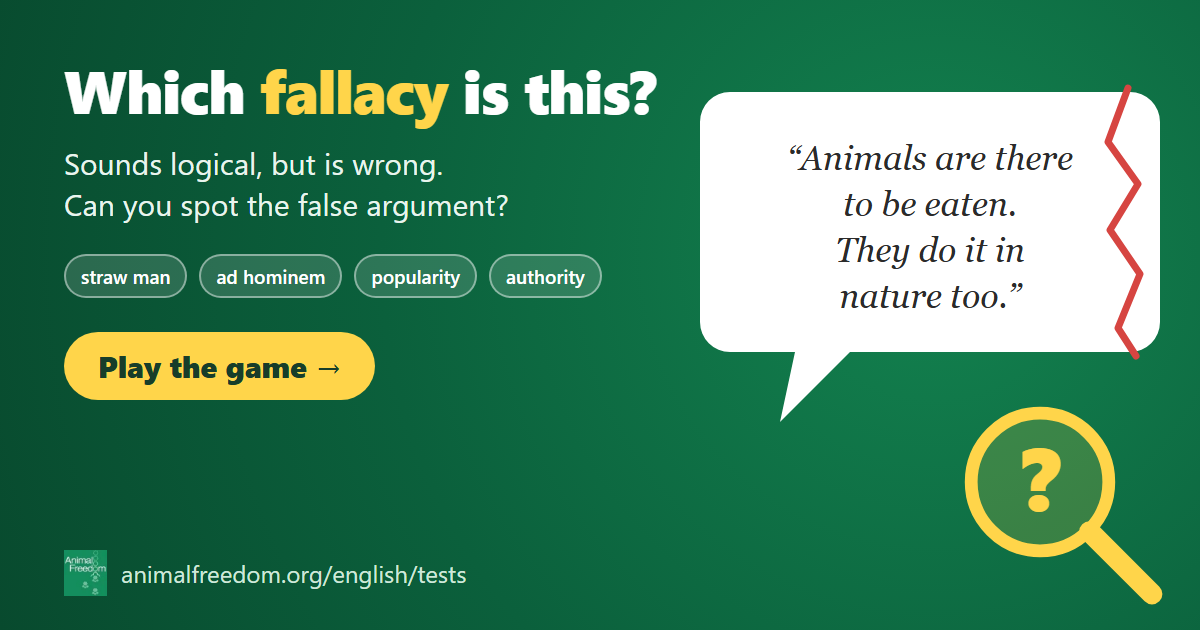
Fallacy: “Animals exist to be eaten, that happens in nature too”.

Counter-argument: In nature, animals do eat each other. But hardly any species imprisons other animals for their entire lives in order to eat them later, as happens in factory farming.

Type: appeal to supposed relation

More: all fallacies about eating meat · Is it right and wise to eat animals? · Meat consumption and its consequences for the world


This article is part of a series on falsities and demagogy

Some arguments used in debate on the topics in the title simply are invalid. That goes for pro and contra.

We selected a few of the most rigid arguments from different situations and placed an appropriate counterargument.

Because a more clear and honest way of reasoning helps improve the circumstances animals live in. Apart from the specific issues there are the types of arguments in general.

Fallacies are deliberately or accidentally used in a debate.

So be aware of the principles and the integrity of an opponent.

Click here for tips on how to react to animal-unfriendly behavior of others.

Non-valid arguments (deceptive arguments) for different groups