Animal rights debate topics and questions |
|
Are you preparing a debate, a presentation or an essay about animals? Here you find questions to discuss, sorted by level. For each question you see an argument you will often hear. Then a point to think about. The link takes you to the full article. Animal Freedom takes a side. We think humans and animals are intrinsically equivalent in their right to a free life. You do not have to agree with us. But a good debate starts with knowing the arguments of both sides. Choose your levelDebate questions for kids (age 8 to 12)Short questions to talk about in class. Each one has a simple answer on our page for kids. May we keep animals in a cage?Often heardThe animal gets food and a warm place. So it is happy. Think aboutFood is not everything. An animal wants to move, explore and choose for itself. Would you swap your freedom for food and a roof? Do we need meat to grow up healthy?Often heardWithout meat you get weak. Think aboutMeat contains nothing your body cannot also get from plants. You do need a varied diet. Vegans need to take extra vitamin B12. Are zoo animals happy?Often heardIn the zoo animals are safe. They are never hungry. Think aboutMany zoo animals miss the space they come from. A polar bear that walks up and down all day is bored. Is it OK to teach animals tricks?Often heardAnimals like doing tricks. Think aboutWould the animal do the trick by itself, without getting food for it? Animals do not want money or applause. Are humans worth more than animals?Often heardHumans are smarter. So they are worth more. Think aboutBeing smart does not give you the right to do whatever you like with another life. Humans and animals both have a right to freedom. Do animals love us?Often heardMy pet loves me. So it is happy with me. Think aboutA pet depends on you for food and company. Is that the same as love? Most animals like their freedom even more. Read: Do animals love humans? All questions with short answers: Questions on animal rights answered for kids. Debate topics for high school (age 12 to 18)Topics that often come up in class debates and essays. Each article lists the usual arguments with a reply. Are humans superior to other animals?Often heardHumans can think, speak and make tools. So we are the superior species. Think aboutMany animals see, smell, hear or run far better than we do. Is our way of thinking a reason to rule over other species? Or a reason to take responsibility for them? Read: Are humans superior to other species? (by Titus Rivas) Is hunting needed to keep nature in balance?Often heardHunters control the number of wild animals. Without hunting there would be too many. Think aboutPredators keep populations healthy because they catch the weak and the sick. A hunter who shoots for pleasure cannot show that he does the same. Large, connected nature areas allow a natural balance. Read: Fallacies surrounding the defence of hunting for pleasure Is eating meat natural?Often heardHumans have always eaten meat. Animals eat each other too. Think aboutHardly any animal in nature locks up other animals all their lives to eat them later. Meat from factory farming is anything but natural. Read: Non-valid arguments for eating meat and Is it correct and wise to eat animals? Do we need factory farming to feed the world?Often heardWithout factory farming there is not enough food for everyone. Think aboutMuch of the feed for farm animals grows in poorer countries. People there could use that land to grow their own food. If plant food were shared fairly, nobody would have to go hungry. Read: Non-valid arguments for maintaining factory farming and Animal Freedom's opinion on factory farming methods Is fish a good alternative to meat?Often heardFish is healthy. It is better for the environment than meat. Think aboutMany fish stocks are overfished. Many other animals die as bycatch. Farmed fish live crowded together without freedom. Fish also feel pain, fear and stress. Should animal testing be banned?Often heardWithout animal testing people would die. There are not enough alternatives. Think aboutRequired by law is not the same as necessary. Much testing is done for commercial reasons. Research with human volunteers and methods without animals often give better results. Read: Non-valid arguments for using animals for experimentation Is fur farming acceptable?Often heardFur is natural. Our farms treat the animals well. Think aboutA wild animal such as a mink suffers in a cage, however good the farm. Many countries have banned fur farming. Faux fur meets the demand for fashion. Is bullfighting culture?Often heardBullfighting is a tradition that is centuries old. Think aboutEvery culture has good traditions and harmful ones. How old a tradition is says nothing about whether it is right. Respect for an animal is not shown through torture. Questions for university and debate clubQuestions about the basis of animal rights. Here Animal Freedom deliberately takes a different path from well-known philosophers such as Peter Singer, Tom Regan and Gary Francione. What is the best basis for animal rights?Often heardAnimals deserve rights because they can suffer (Singer). Or because they are the subject of a life (Regan). Think aboutBoth views start from how much animals resemble us. An animal that resembles us less then gets less protection. Animal Freedom chooses freedom as the basis: every animal is entitled to a natural, free life. Read: Freedom, not similarity, is the basis for animal rights and Animal rights and the theory behind it Can animals have rights without duties?Often heardRights come with duties. Animals cannot take on duties. So they cannot have rights. Think aboutAnimals do not need to understand rights. Animal rights are human rights that set limits on how people treat animals. The duties lie with us, because we are the more powerful party. Does "intrinsic value" protect animals?Often heardAnimals have intrinsic value. So we must respect them. Think aboutEverything has intrinsic value, even a grain of sand. A term that applies to everything protects nothing. Freedom draws a much clearer line. Read: Do animals have intrinsic value? and Why do animals have rights? Not because of intrinsic value Where does use of animals become abuse?Often heardWe are free to use animals as we see fit. Think aboutFreedom always has limits. Our freedom stops where we take away the freedom of another being, human or animal. Use is not wrong in itself. The question is where it turns into abuse. Read: Drawing the line for freedom to abuse animals and Freedom is a basic animal right just as it is for us Should wild animals and farm animals have the same rights?Often heardWild animals are protected as a species. Farm animals are protected by welfare laws. That is enough. Think aboutNature laws protect species, not the individual animal. Welfare laws treat animals as property. Neither protects the freedom of the animal itself. Abolish all animal use, or improve welfare step by step?Often heardBigger cages are a step in the right direction. Or the opposite view: only ending all animal use counts (Francione). Think aboutBigger cages do not give freedom. Ending all use goes further than needed. Clear principles work better in the long run than vague goals and compromises. Read: The animal rights movement is not always as effective as it could be and An interview with Professor Gary L. Francione (Animal Freedom sees it differently) Debating fairlyA good debate needs sound arguments. Both sides sometimes use fallacies. That includes people who stand up for animals. Learn to spot them, in others and in yourself:
Practise with the game below: Which fallacy is this? Test yourself
Looking for more? Our reading guide leads you to the right article with one question: Think and discuss. |
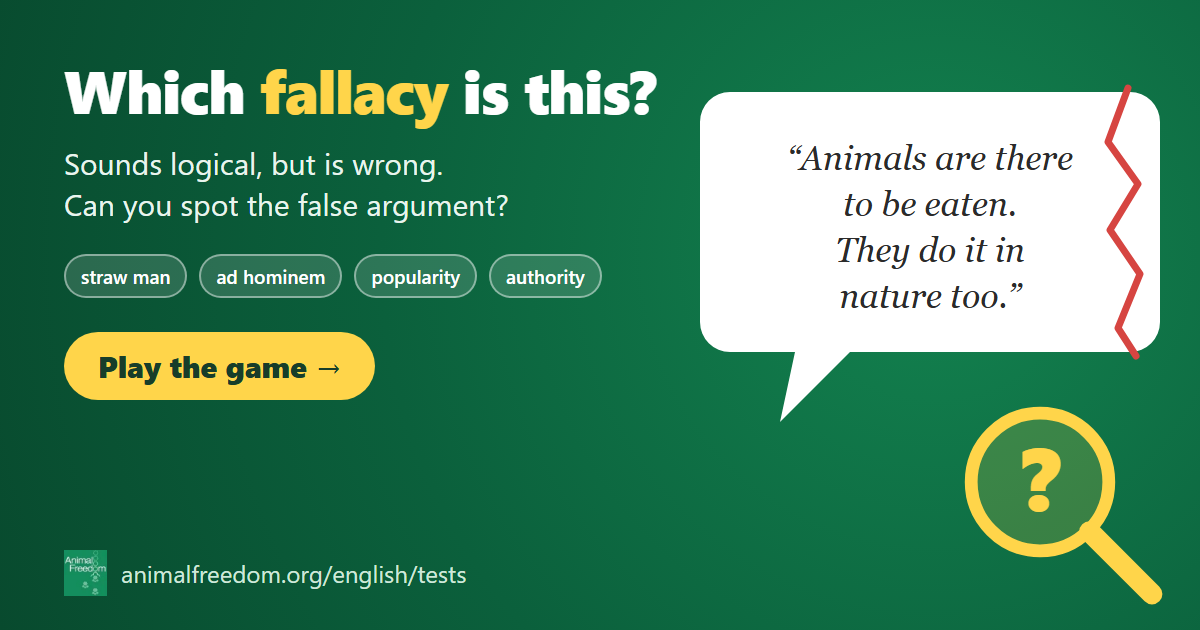
Test yourself: which fallacy is this? Ten statements about animals that you hear all the time. Can you spot the fallacy? After each answer you read why it does not hold. Play the game → |
This article is part of a series on fallacies and demagogy |
Some arguments used in debate on the topics in the title simply are invalid. That goes for pro and contra. We selected a few of the most rigid arguments from different situations and placed an appropriate counterargument. Because a more clear and honest way of reasoning helps improve the circumstances animals live in. Apart from the specific issues there are the types of arguments in general. Fallacies are deliberately or accidentally used in a debate. So be aware of the principles and the integrity of an opponent. How do you respond to fallacies? Six tipsGive the other person the benefit of the doubt. Start by assuming a misunderstanding, not deliberate deception. Even someone who keeps using fallacies may simply be badly informed or emotionally involved.
See also how to respond to animal-unfriendly behaviour of others. |
Non-valid arguments (deceptive arguments) for different groups |
 |
|
|||||