Causes of animal-unfriendly behaviour |
The following causes of animal-unfriendly behaviour can be found
Traditions that can sometimes be traced back a long
time, such as hunting and ritual
slaughter.
Ideology, such
as the notion that mankind can and should rule animals.
Religion, for example Mithraism. In Roman times this religion was
an important rival of Christianity. Practitioners
of Mithraism used to sacrifice a bull every year,
and because of the rivalry between these two religions,
the Christians decided to mix the imagery of the devil
with that of the bull. It is possible that bull-fighting
finds its origin in the ritual slaughter of bulls
in the times of Mithraism. It was said that a bull's
blood would purge one of one's sins, f.e. the "feast"
of Farra Do Boi in Brazil.
Ignorance, be it or
not on purpose. Indifference,
powerlessness and denial. Arrogance,
inability of man to accept the equal rights of other
living souls. Economic gain, sometimes
pushed to extremes.
Image building, "look at me", being stronger
than animals (circus, hunting and bull-fighting),
or with remarkable pets,
or by wearing e.g. fur coats to look 'pretty'.
The way people treat animals reflects their beliefs,
values, knowledge and the importance of the animal for
them, either financially, socially or morally. |
Harmful traditions should become extinct
We humans have traditions. Some of them are harmful, and this is not a matter of preference, but of ethical reality. Bullfighting, fireworks, and the large-scale production and export of animal products cause structural harm to animals, nature, and society, while the enjoyment or economic benefit is limited and unequally distributed.
The argument that participation is voluntary – you don’t have to watch bullfighting, you don’t have to buy salmon – ignores that the consequences for others are not voluntary. No one can escape polluted water, damaged ecosystems, declining biodiversity, or a living environment periodically disrupted by noise and violence against animals. Freedom of consumption does not justify collective harm and must never come at the expense of the equal worth of others, human or animal.
That not everyone suffers equally from these consequences does not make them any less serious. Precisely the fact that the burdens are diffuse and unevenly distributed highlights the need for moral responsibility. Freedom without respect for the equal worth of all that is affected is not true freedom.
Yet measures to address harmful traditions are often delayed with the argument that people earn their livelihood from them. This elevates economic dependence to a moral justification. As if preserving a source of income outweighs animal welfare, ecological integrity, and the livability of our environment.
Traditions deserve no protection simply because they are old, but only as long as they are compatible with freedom and equal worth. When a tradition demonstrably causes harm, it is no longer cultural heritage, but a moral problem. And moral problems do not call for delay, but for termination. |
Humans and animals are equal in their right to freedom
People who eat meat often point to nature:
Eating and being eaten are part of it. That is true.
But in nature, it is also true that an animal lives freely and, when it is careful and takes good care of itself, can often survive for a long time.
Moreover, there is love in the wild: between parents and their young, in care, protection, and closeness.
Independent of these forms of affection, humans and animals are equal in their right to freedom, while differences in other respects relate to biodiversity.
Precisely because animals do not live to be used, but to live their own lives, the way we treat them is not a matter of choice. Those who take freedom for themselves seriously cannot carelessly disregard that same freedom in another living being. |
|
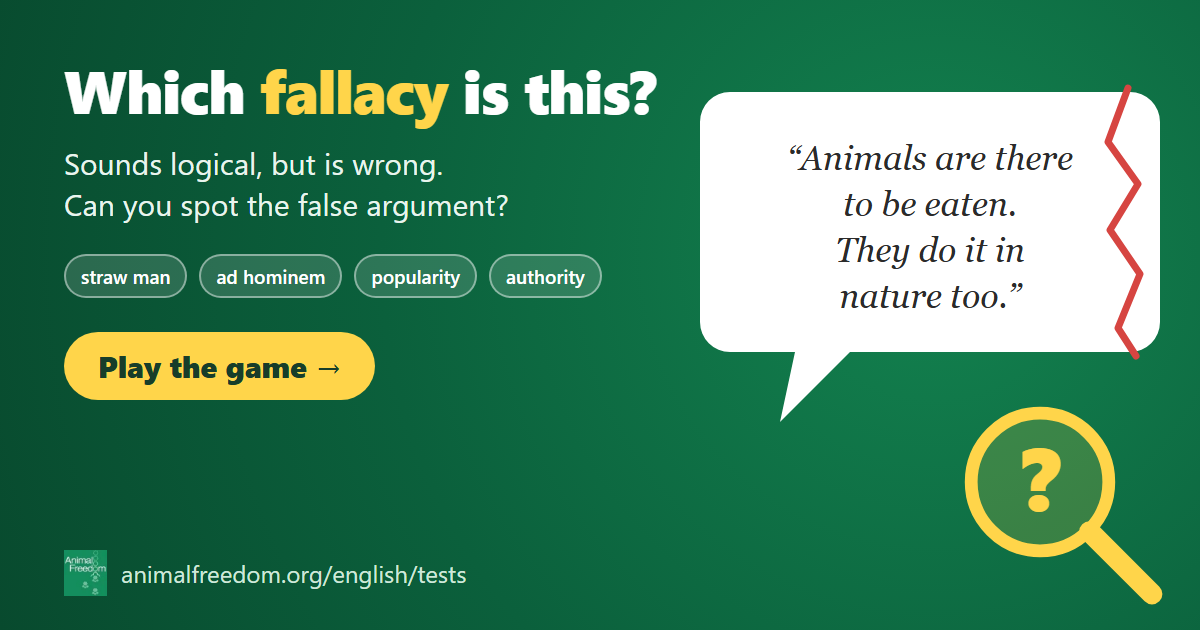
Test yourself: which fallacy is this?
Ten statements about animals that you hear all the time. Can you spot the fallacy? After each answer you read why it does not hold.
Play the game →
|
This article is part of a series on fallacies and demagogy |
Some arguments used in debate on the topics in the title simply are invalid.
That goes for pro and contra.
We selected a few of the most rigid arguments from
different situations and placed an appropriate counterargument.
Because a more clear and honest way of reasoning helps improve the circumstances animals live in.
Apart from the specific issues there are the types of
arguments in general.
Fallacies are deliberately or accidentally used in a debate.
So be aware of the principles and the integrity of an opponent.
How do you respond to fallacies? Six tips
Give the other person the benefit of the doubt. Start by assuming a misunderstanding, not deliberate deception. Even someone who keeps using fallacies may simply be badly informed or emotionally involved.
- Mind the context. In a friendly conversation a gentle approach works better than in a formal debate. Adapt to your relationship with the other person and to the aim of the conversation.
- Stay calm. Fallacies are often meant to stir up emotions. Keep your own emotions in check.
- Identify the fallacy. Try to understand where the reasoning goes wrong. Do this for yourself, not to catch the other person out.
- Answer the fallacy. Ask clarifying questions or explain why the argument does not convince you. Avoid technical terms.
- Stay on topic. Bring the conversation back to what it is about and keep it on a rational level.
- Be prepared. If you know you will talk to someone who often uses fallacies, gather some facts and arguments beforehand.
See also how to respond to animal-unfriendly behaviour of others. |
Non-valid arguments (deceptive arguments) for different groups
|
|