Exploitation of man and animals for economic reasons |
Modern slavery in the stable
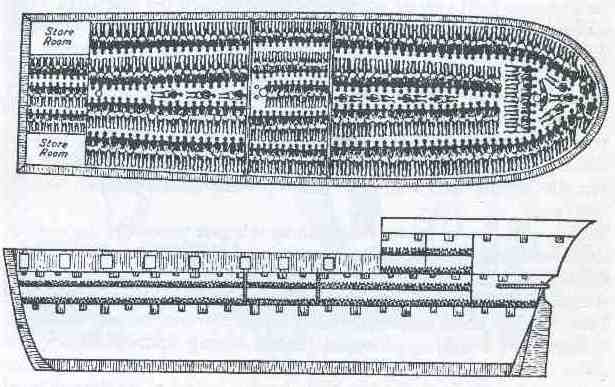
In the sixteenth and seventeenth centuries western people used to travel to Africa to enslave black people and take them away to work on plantations in the "New World". Nowadays some people in poorer countries work voluntarily for western entrepreneurs when they are tempted not to grow crops for the local market but to grow fodder for the western factory farming industry.
In countries with factory farms animals are exploited as modern slaves, treated just as inhumanely as the "old" human slaves were and just as invisibly. |
|
Economic doctrine and debt burden
Most Westerners have pulled out of the developing areas; however, their investments have remained. Developing countries can free themselves from the burden of debt when they agree to produce for western countries. The former yoke of bondage has been replaced by the leading strings of our economic doctrine. The Global South is still under the spell of our economic conviction: "produce fodder and thou shalt be rich soon and freedom will result".
The flipside is that the local economies have become disrupted and the local population has little to eat or is forced to destroy a new part of the rainforest in order to grow some crops for themselves.
This way the Global South has not only sold out its raw materials but the local market has also become the place to sell off western overproduction. When they object to this unequal competition Western governments offer to remove barriers to the Western market, while subsidizing their own entrepreneurs with taxpayers' money. |
Automation has brought about an increase in production and higher profits
Meanwhile factory farming in Western countries is no longer restricted by small-scale production: the farmer is given the opportunity to keep a great number of animals. He often lives away from the farm, in order not to be constantly reminded by the smell and ugliness of the stables and the way he earns his money. There is little demand for laborers and the banks and fodder industry cooperate in financing and building big stables. This way it is much easier and cheaper to supply fodder and collect products and animals. The only thing for the farmer to organize is a location to dump the manure, which is injected into the ground as soon as possible.
The whole world has become a global market for meat consumption; only legal restrictions to protect the environment sometimes limit the unbridled growth of factory farming. |
Nobody is confronted with the abuse that takes place in factory farming
Because of the hidden production behind closed stable doors the public is unaware of what is going on and is unlikely to protest. In contrast to the modern way of farming and reminiscent of the old way there are often little goats and pot-bellied pigs in the front yard of the factory farms.
Many of the changed circumstances have a positive component: a lot of hard, labor-intensive work now belongs to the past. The negative side is that the gained energy is not put into positive goals, but directed to gaining more money. A small group of entrepreneurs profit directly. The public profits indirectly because of the low prices for meat.
Greed, easy money and ostentation (another reason to keep exotic pets) make the animals in factory farms groan under the yoke of modern slavery. It is the animal that is paying a high price for the profits of modern farming. In exchange for good care, though limited and completely focused on fast growth without problems, the animals are left with nothing but boredom, awaiting slaughter. No action is undertaken that does not serve the purpose of making more money, leaving the animals in conditions of utter boredom and misery. As modern slaves animals have a right to freedom too. It is the same freedom that is misused by the factory farmer in order to build his empire. |
Shared responsibility for animal freedom
Freedom used to violate animal freedom must be curbed, otherwise freedom will turn into its opposite. Revolution on the part of the animal is not to be expected; instead we get scandals like harmful hormones, resistant germs, dioxin contamination, BSE and swine fever.
It is everybody's task to defend the borders of freedom: government, consumers, meat producers, banks and the business world. In the old days one would call for solidarity with the weaker party, but nowadays this would not help, because responsibility is spread over too many parties.
It is easy to avoid responsibility and the animal is unable to stand up and fight for its own rights. The consumer cries out "I don't have time to buy ecological meat" and states, together with the farmers, that "it is up to the government to make factory farming less attractive and make ecological farming more attractive". Because of this attitude the lives of farm animals are expected to improve only slowly. |
The solution: implementing freedom
People in our society, quite rightly, are unwilling to be forced into moral norms and values. Society is likely to function properly when it consists of individuals who behave in a responsible way when not being monitored all of the time. For example when consumers stop buying factory farm products, when animals from the wild are no longer hunted for pleasure only or when harmful substances are no longer mixed into fodder. The solution is to actually implement freedom in our society and our minds.
This means that freedom:
- must be limited (no import of fodder from poorer countries or of exotic animals; no export of animal products)
- must be made explicit (what are minimal requirements for animal freedom)
- must be guarded and monitored (the freedom of a factory farmer ends where the freedom of animals begins)
This means also:
- No subsidy and other support for unfair economic competition.
- People should free themselves from all kinds of enslaving habits that prevent them from taking responsibility for their own behavior and they should learn to act effectively to improve the lives of animals.
Human action tends to be motivated by economic interests. Improving conditions for animals should therefore be positively linked to our economic interest, whereby the goals and methods are directed to enlarging the freedom for as many parties as possible.
Factory farming should be economically unattractive and ecological stock farming should be given a fair chance. This way real freedom is implemented in the whole range of our society.
See also: Hermine feels a deep solidarity with nature. |
See also: Are humans superior to other species?
|
Test yourself: which fallacy is this?
Ten statements about animals that you hear all the time. Can you spot the fallacy? After each answer you read why it does not hold.
Play the game →
|
This article is part of a series on fallacies and demagogy |
Some arguments used in debate on the topics in the title simply are invalid.
That goes for pro and contra.
We selected a few of the most rigid arguments from
different situations and placed an appropriate counterargument.
Because a more clear and honest way of reasoning helps improve the circumstances animals live in.
Apart from the specific issues there are the types of
arguments in general.
Fallacies are deliberately or accidentally used in a debate.
So be aware of the principles and the integrity of an opponent.
How do you respond to fallacies? Six tips
Give the other person the benefit of the doubt. Start by assuming a misunderstanding, not deliberate deception. Even someone who keeps using fallacies may simply be badly informed or emotionally involved.
- Mind the context. In a friendly conversation a gentle approach works better than in a formal debate. Adapt to your relationship with the other person and to the aim of the conversation.
- Stay calm. Fallacies are often meant to stir up emotions. Keep your own emotions in check.
- Identify the fallacy. Try to understand where the reasoning goes wrong. Do this for yourself, not to catch the other person out.
- Answer the fallacy. Ask clarifying questions or explain why the argument does not convince you. Avoid technical terms.
- Stay on topic. Bring the conversation back to what it is about and keep it on a rational level.
- Be prepared. If you know you will talk to someone who often uses fallacies, gather some facts and arguments beforehand.
See also how to respond to animal-unfriendly behaviour of others. |
Non-valid arguments (deceptive arguments) for different groups
|
|
